iPhone版
  Android版
 和顺古镇导游词(中英文对照)
Heshun Ancient Town Guide Commentary (Bilingual)
陈大衡&AI
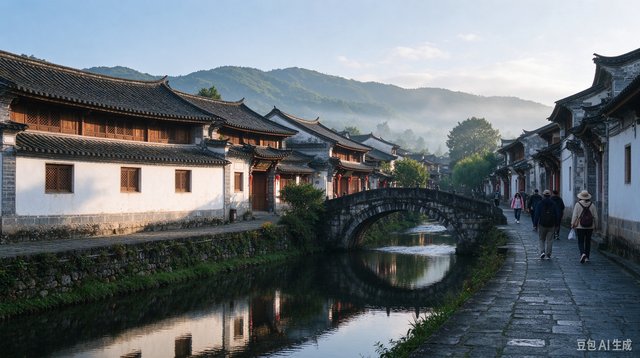
开场白 / Opening Welcome
各位团友,大家好!欢迎来到腾冲和顺古镇。和顺位于腾冲市区以西三公里处,是中国十大魅力名镇之首,也是中国著名的侨乡。今天我们的游览大约需要四到五个小时,我将带大家走一条经典路线:牌坊—双虹桥—禹州亭—和顺图书馆—寸氏宗祠—刘氏宗祠—李氏宗祠—弯楼子民居—艾思奇故居—元龙阁—中天寺。请大家跟紧队伍,我们现在就出发!
Good morning, everyone, and welcome to Heshun Ancient Town in Tengchong! Heshun sits just three kilometers west of the county seat, and it's known as the foremost of China's "Ten Most Charming Towns" — as well as one of the country's most famous hometowns of overseas Chinese. Our visit today will take roughly four to five hours, and we'll follow a classic route: the Memorial Archway, the Shuanghong Bridges, Yuzhou Pavilion, the Heshun Library, the ancestral temples of the Cun, Liu, and Li families, the Wanlouzi residence, Ai Siqi's former home, Yuanlongge Temple, and finally Zhongtian Temple. Please stay close, and let's begin!
第一站:牌坊 / Stop 1: The Memorial Archway
各位请看眼前这座牌坊,上面镌刻着"和顺顺和"四个字。这里巧妙地运用了回文的修辞手法,无论正读反读都是"和""顺"二字的组合,寄托着当地人对美好生活的祈愿。"和顺"这个名字其实还有另一层来历——古镇依三合河而建,本意是"顺河",后人又取"云涌吉祥,风吹和顺"的诗句寓意,才有了今天这个既写实又吉祥的名字。牌坊的背面还题有"仁里"二字,是清代才子赵藩所书,意思是说和顺是一方讲究传统道德、仁义礼节的乡土。
Take a look at the archway in front of us — inscribed with the four characters "He Shun Shun He." It's a clever palindrome: read forwards or backwards, it always spells out "harmony" and "peace," expressing the local people's wish for a good life. The name "Heshun" actually has two layers of meaning: the town was built along the Sanhe River, so it originally meant "following the river," and later generations added the poetic idea of "auspicious clouds rising, gentle winds bringing harmony." On the back of the archway you'll notice the characters "Ren Li" — written by the Qing-dynasty scholar Zhao Fan — meaning that Heshun is a community deeply rooted in traditional virtue and propriety.
第二站:双虹桥 / Stop 2: The Shuanghong Bridges
我们现在来到的是三合河上的双虹桥。三合河自东向西穿镇而过,河上两座石拱桥远远望去就像天边的两道彩虹,因此得名"双虹桥"。这里的风景四季皆宜——春天游人常来踏青,秋天则是赏月的绝佳去处。大家可以在这里稍作停留,拍几张照片,感受一下小桥流水人家的江南意境。
Now we've arrived at the Shuanghong Bridges over the Sanhe River. The river flows through town from east to west, and its two stone arch bridges look, from a distance, like a pair of rainbows arching over the water — hence the name "Double Rainbow Bridges." The scenery here is lovely in every season: locals come for spring outings and for moon-viewing in autumn. Feel free to pause here for some photos and take in this classic "small bridge, flowing water" scene.
第三站:禹州亭 / Stop 3: Yuzhou Pavilion
桥边这一片荷塘中央,有一座亭子,叫禹州亭。它是为了纪念寸树声先生而建的——寸树声曾任和顺育群中学首任校长,后来担任云南大学副校长,是当地重教尊师传统的代表人物。亭内悬挂的匾额,是由全国人大常委会原副委员长楚图南先生题写的。透过这座小小的亭子,大家可以感受到和顺人"耕读传家"的深厚情结。
In the middle of this lotus pond beside the bridge stands Yuzhou Pavilion, built in memory of Mr. Cun Shusheng — the first principal of Heshun's Yuqun Middle School, who later became vice president of Yunnan University. He's a fitting symbol of the town's deep respect for education and teachers. The tablet inside was inscribed by Chu Tunan, a former vice chairman of the Standing Committee of the National People's Congress. Even this small pavilion reflects Heshun's long tradition of valuing both farming and learning.
第四站:和顺图书馆 / Stop 4: Heshun Library
接下来我们要参观的,是和顺最引以为傲的一张"名片"——和顺图书馆,它是中国创办最早、规模最大的乡村图书馆。清朝末年,和顺曾有一个进步团体叫"咸新社";1924年,一批旅缅华侨又组织了"崇新会",创办刊物、设立读书会。1928年,在华侨和乡贤的共同努力下,读书会扩建成了图书馆。1938年因藏书渐多,又在原址重建了新馆,面积达1450平方米,是一座中西合璧的两层建筑,楼上藏书、楼下阅览。馆内至今保存着胡适、李石曾、熊庆来、廖承志等文化名人的题字,如今是国家级重点文物保护单位。走进去看看,你会看到当地农民读报、学生温书的场景——这里被和顺人称为"第二课堂",足见一个只有几千人的小镇,对文化教育有着怎样深厚的情结。
Our next stop is Heshun's proudest landmark — its library, the earliest and largest rural library in all of China. In the late Qing dynasty, a progressive society here called "Xianxinshe" promoted new ideas and culture. Then in 1924, overseas Chinese living in Myanmar formed another progressive group, the "Chongxin League," which launched a publication and a reading club. By 1928, with joint efforts from overseas Chinese and local gentry, that reading club grew into a full library, and in 1938 — as the collection kept growing — a new two-story building of 1,450 square meters went up on the same site, blending Chinese and Western architectural styles, with stacks upstairs and reading rooms below.
It still holds inscriptions from cultural giants like Hu Shi, Li Shizeng, Xiong Qinglai, and Liao Chengzhi, and today it's a nationally protected historic site. Step inside and you'll likely see farmers reading the newspaper and students reviewing their lessons — locals call it their "second classroom." For a town of only a few thousand residents, that's a remarkable testament to how deeply Heshun values education.
第五站:寸氏宗祠 / Stop 5: The Ancestral Temple of the Cun Family
现在我们来到了和顺八大宗祠中修建最早的一座——寸氏宗祠,始建于清嘉庆年间。1935年重修大门时,巧妙融入了西式建筑元素,是汉文化与海外文化交融的典范。进门之后,大家可以看到明代皇帝赐给寸氏先祖寸禹的匾额——寸禹曾引大盈江水灌溉和顺坝子,又修建三合河供全村用水,因此受到皇帝嘉奖。大殿外墙绘有"二十四孝"的故事图案,殿内则以儒家伦理为家训,可见寸氏一族对礼义教化的重视。
We've now reached the earliest-built of Heshun's eight ancestral temples — the Cun family temple, first constructed during the Jiaqing era of the Qing dynasty. When its gate was rebuilt in 1935, Western architectural touches were skillfully worked in, making it a fine example of Chinese and overseas cultural fusion.
Just inside, you'll see a tablet granted by a Ming-dynasty emperor to the family's ancestor, Cun Yu, who diverted water from the Dayingjiang River to irrigate Heshun's fields and built the Sanhe River to supply the whole village with water — earning him imperial commendation. Outside the main hall, the walls are decorated with scenes from the "Twenty-Four Tales of Filial Piety," and inside, Confucian ethics were adopted as the family's guiding code — a clear sign of how much importance the Cun family placed on propriety and moral teaching.
第六站:刘氏宗祠 / Stop 6: The Ancestral Temple of the Liu Family
刘氏宗祠建于清咸丰五年,坐落在一处山谷之中。大家看,大门前有一方半月形的池塘,池塘上架着一座双孔石拱桥,桥与大门之间还设有一座半月形的月台,大门本身则是一座精美的装饰牌坊。整座祠堂由正殿、厢房和廊道组成,庭院里种着梅、兰、竹、菊——也就是中国传统文化里的"四君子",象征着刘氏家族对高洁品格的追求。
The Liu family's ancestral temple was built in the fifth year of the Xianfeng era and sits nestled in a small valley. Notice the semicircular pond in front of the gate, spanned by a two-arch stone bridge, with a semicircular terrace between the bridge and the entrance — and the gate itself is an elaborately decorated archway. The temple complex is made up of a main hall, side chambers, and covered walkways, and the garden is planted with plum, orchid, bamboo, and chrysanthemum — the "Four Gentlemen" of Chinese tradition, symbolizing the noble character the Liu family aspired to.
第七站:李氏宗祠 / Stop 7: The Ancestral Temple of the Li Family
李氏宗祠依山而建,气势格外恢宏。大家请拾级而上,先经过一座石牌坊,来到一处平台;抬头望去,三十多级扇形石阶通向一座雕花牌坊,那就是宗祠正门。这样层层递进的布局,营造出一种庄严肃穆的仪式感,也体现了李氏一族深厚的家族底蕴——从这里走出的李曰垓,是同盟会成员,护国运动《讨袁檄文》的起草者,是近代云南重要历史人物。
The Li family's ancestral temple, built up the slope of a hill, has an especially grand and commanding presence. Climb the stairs with me: first through a stone memorial archway to a platform, then look up — more than thirty fan-shaped stone steps lead up to a carved, decorated archway, which is the temple's main gate.
This layered, ascending design creates a real sense of solemn ceremony, reflecting the deep heritage of the Li family, which produced Li Yuegai — a member of the Tongmenghui (United League), author of the "Denunciation of Yuan Shikai" during the National Protection Movement, and an important historical figure in modern Yunnan.
第八站:弯楼子民居 / Stop 8: The Wanlouzi Residence
穿过几条巷子,我们来到"弯楼子"民居。它之所以得名"弯楼子",是因为整座建筑顺应地形和河道弯曲而建,楼身呈弧形转折,是和顺众多百年宅院中极具代表性的一座。这些民居大多由旅居海外经商致富的和顺人出资兴建,既保留了徽派建筑粉墙黛瓦的婉约气质,又融入了西式建筑的明朗线条,处处可见南洋风情的影响——一砖一瓦,都是"侨乡"二字最生动的注脚。
Walking through a few more alleyways brings us to the Wanlouzi Residence. It gets its name — meaning "curved building" — because its structure bends along the shape of the terrain and the riverbank. It's one of the most representative of Heshun's many century-old homes.
Most of these residences were funded by Heshun natives who made their fortunes overseas, and you can see it in the architecture: the graceful whitewashed walls and dark tiled roofs of the Hui style, blended with the clean lines of Western buildings and touches of Southeast Asian influence. Every brick and tile here tells the story of what it means to be a "hometown of overseas Chinese."
第九站:艾思奇故居(纪念馆) / Stop 9: Ai Siqi's Former Residence (Memorial Hall)
现在我们来到了和顺最著名的历史人物故居——艾思奇纪念馆。这座宅院是艾思奇的父亲李曰垓于1919年修建的,前临元龙幽潭,后枕凤山,是一座中西合璧的砖木结构四合院。艾思奇原名李生萱,1910年出生在和顺水碓村,是我国著名的马克思主义哲学家、教育家。
他撰写的《大众哲学》和《哲学与生活》,曾引导无数青年走上革命道路;他的《辩证唯物主义和历史唯物主义》一书,长期是我国高等院校的哲学教材。可以说,和顺这样一个小镇,能孕育出如此重量级的哲学家,与它开放包容、重视教育的文化底色密不可分。
We've now reached the memorial hall of Heshun's most celebrated historical figure — Ai Siqi. This residence was built in 1919 by his father, Li Yuegai, fronting the secluded Yuanlong Pond and backed by Feng Hill — a courtyard house of brick-and-timber construction blending Chinese and Western styles. Ai Siqi, born Li Shengxuan in 1910 in Heshun's Shuidui Village, went on to become one of China's foremost Marxist philosophers and educators.
His books *Philosophy for the Masses* and *Philosophy and Life* guided countless young people toward revolution, and his work *Dialectical and Historical Materialism* served for decades as a standard philosophy textbook in Chinese universities. It's really no coincidence that a small town like Heshun — open, cosmopolitan, and deeply committed to education — could produce a thinker of this caliber.
第十站 & 第十一站:元龙阁 / 中天寺 / Stops 10 & 11: Yuanlongge Temple & Zhongtian Temple
我们游览的最后两站是元龙阁和中天寺。这两处寺观依山傍水,与前面的宅院、宗祠相映成趣,共同构成了和顺"寺院、道观、祠堂与百年宅院交错分布"的古镇格局。漫步在这里,大家可以感受到六百多年来中原汉文化、西洋南洋文化、滇西本土边地文化在这片土地上交融碰撞,最终孕育出和顺独特的侨乡文化与马帮文化。
Our final two stops are Yuanlongge Temple and Zhongtian Temple. Nestled among the hills and waterways, these temples complement the residences and ancestral halls we've already seen, together forming Heshun's distinctive layout of temples, Taoist shrines, ancestral halls, and century-old homes woven together.
Walking through here, you can really feel how, over more than six hundred years, Central Plains Han culture, Western and Southeast Asian culture, and the indigenous borderland culture of western Yunnan all mingled on this soil — giving rise to Heshun's one-of-a-kind culture of overseas Chinese heritage and caravan trade.
结束语 / Closing
各位团友,今天的和顺之行就要告一段落了。从牌坊到宗祠,从图书馆到名人故居,我们看到的不仅是青砖黛瓦、小桥流水,更是一代代和顺人"走夷方、闯南洋"、心系故土、崇文重教的精神传承。感谢大家的陪同,希望和顺的这份"侨乡记忆"能给大家留下深刻的印象!
That brings us to the end of today's tour of Heshun. From the memorial archway to the ancestral temples, from the library to the philosopher's former home, what we've seen is more than just gray tiles and flowing water — it's generations of Heshun people who ventured abroad to Myanmar and beyond, never forgetting their roots, and always prizing education and culture. Thank you all for joining me today — I hope this glimpse into Heshun's "hometown of overseas Chinese" heritage stays with you!
文化旅游观察者
人民号优选号主